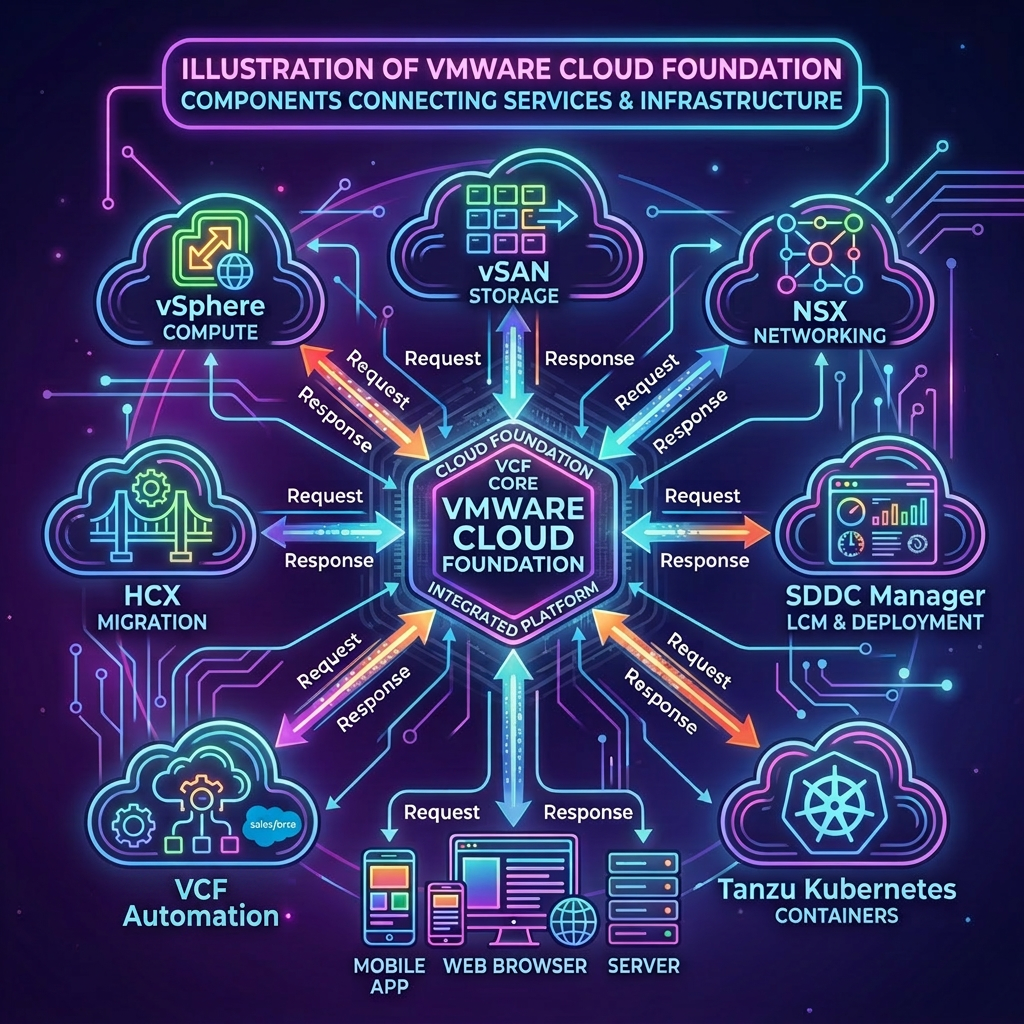
During the initial deployment of your VMware Cloud Foundation platform, the VCF Installer deploys VCF Operations with a single Cloud Proxy. If you want to increase availability if metric and log collection you can deploy additional Cloud Proxies and then create a Cloud Proxy Group, this way if a Cloud Proxy goes offline the adapters will reconnect to the remaining Cloud Proxy and continue to collect data.
In this post we will look at how an additional Cloud Proxy can be deployed using the public APIs, this is achieved via the VCF Fleet Lifecycle Service which is tightly integrated into VCF Operations.
VCF Fleet Lifecycle Service APIs Used
- POST /api/v1/identity/token
- GET /fleet-lcm/v1/sddc-lcms
- GET /fleet-lcm/v1/components
- POST /fleet-lcm/v1/components/validations
- GET /fleet-lcm/v1/tasks/{taskId}
- PATCH /fleet-lcm/v1/components/{componentId}
Procedure
-
Connect to a system that has access to the infrastructure and is capable of running CURL.
-
Replace the values in the sample code with values for your VCF Fleet Lifecycle Service and paste the commands in the console. If your not sure which endpoint this FQDN should be log into VCF Operations, go to Build > Lifecycle > VCF Management and select the Components tab and locate the component named Fleet lifecycle the FQDN is shown in the FQDN column.
export vcfFleetLifecycleFqdn='flt-fc01.rainpole.io'
export vcfFleetLifecycleUser='admin@vsp.local'
export vcfFleetLifecyclePass='VMw@re1!VMw@re1!'
- Authenticate to the VCF Fleet Lifecycle Service and obtain a token by running the following command:
vcfFleetLifecycleToken=$(curl -k -X POST "https://$vcfFleetLifecycleFqdn/api/v1/identity/token" \
    -H 'Content-Type: application/x-www-form-urlencoded' \
    --data "grant_type=password" \
    --data "username=$vcfFleetLifecycleUser" \
    --data "password=$vcfFleetLifecyclePass" \
    | jq -r '.access_token')
- Verify you successfully obtained an authentication token by running the following command:
echo $vcfFleetLifecycleToken
Example Output:
eyJhbGciOiJFZERTQSIsImtpZCI6InVDQnd3ME9IMDBMYzV6c1ZJSlRLUWd2Z0VpbjZrNW80dmpJa1A0NkhiMWsiLCJ0eXAiOiJKV1QifQ.eyJpc3MiOiJodHRwczovL2ZsdC1mYzAxLnJhaW5wb2xlLmlvIiwic3ViIjoiYWRtaW5AdnNwLmxvY2FsIiwiYXVkIjpbInZzcCJdLCJleHAiOjE3ODM5NzM3MDEsImlhdCI6MTc4Mzk1OTMwMSwianRpIjoiMTBjYWRkZWQtMDVmZi00YTc0LWJhMWYtMWVlOTVlNzJjYWFkIiwiYXpwIjoicGFzc3dvcmRfZ3JhbnRfY2xpZW50IiwiYWNjdCI6ImFkbWluQHZzcC5sb2NhbCIsImF1dGhvcml6YXRpb25fZGV0YWlscyI6bnVsbH0.ssr0vXiaZqNqQeugUKMoK37--UwimGEN5otcsEyrUtakHFP8QLXwRA26cwp5XMw7deAsbdXp9aDlYl8LOGM7CQ
- First we retrieve the unique ID of the SDDC instance by running the following command:
primarySddcLcms=$(curl -k -X GET "https://$vcfFleetLifecycleFqdn/fleet-lcm/v1/sddc-lcms" \
  --header "Authorization: Bearer ${vcfFleetLifecycleToken}" \
  --header "Accept: application/json" \
  --header "Content-Type: application/json" \
  | jq -r '.sddcLcms[] | select(.isPrimary == true) | .id')
- Verify you successfully obtained the SDDC instance ID by running the following command:
echo $primarySddcLcms
Example Output:
3e8d0034-906b-49cb-9c47-3afa8d919192
- Next we retrieve the component ID of VCF Operations instance by running the following command:
vcfOperationsId=$(curl -k -X GET "https://$vcfFleetLifecycleFqdn/fleet-lcm/v1/components" \
  --header "Authorization: Bearer ${vcfFleetLifecycleToken}" \
  --header "Accept: application/json" \
  --header "Content-Type: application/json" \
  | jq -r '.components[] | select(.componentTypeDescription == "VCF Operations") | .id')
- Verify you successfully obtained the component ID of VCF Operations instance by running the following command:
echo $vcfOperationsId
Example Output:
32dfaec2-ff61-4d16-bfbd-4a3b929b1a16
- Replace the values in the sample code with values for the deployment of your Cloud Proxy instance and paste the commands in the console.
export cloudProxyFqdn='sfo-cp02.sfo.rainpole.io'
export cloudProxyPass='VMw@re1!VMw@re1!'
export cloudProxyAdminPass='VMw@re1!VMw@re1!'
- Create the JSON payload for the Cloud Proxy deployment by running the following command:
cat << EOF > cloud-proxy-deploy.json
{
  "deploymentType": "OvaComponentUpdateSpec",
  "componentType": "OPS",
  "nodeSpecs": [
    {
      "nodeType": "ONE_WAY_REMOTE_COLLECTOR",
      "sddcLcmId": "${primarySddcLcms}",
      "deploymentSpec": {
        "fqdn": "${cloudProxyFqdn}",
        "password": "${cloudProxyPass}",
        "deploymentOption": "standard"
      }
    }
  ],
  "configSpec": {
    "adminPassword": "${cloudProxyAdminPass}"
  }
}
EOF
- Verify the JSON payload has been populated correctly by running the following command:
cat cloud-proxy-deploy.json
Example Output:
{
  "deploymentType": "OvaComponentUpdateSpec",
  "componentType": "OPS",
  "nodeSpecs": [
    {
      "nodeType": "ONE_WAY_REMOTE_COLLECTOR",
      "sddcLcmId": "3e8d0034-906b-49cb-9c47-3afa8d919192",
      "deploymentSpec": {
        "fqdn": "sfo-cp02.sfo.rainpole.io",
        "password": "VMw@re1!VMw@re1!",
        "deploymentOption": "standard"
      }
    }
  ],
  "configSpec": {
    "adminPassword": "VMw@re1!VMw@re1!"
  }
}
- Validate the JSON payload by running the following command:
validationId=$(curl -k -X POST "https://$vcfFleetLifecycleFqdn/fleet-lcm/v1/components/validations" \
  --header "Authorization: Bearer ${vcfFleetLifecycleToken}" \
  --header "Accept: application/json" \
  --header "Content-Type: application/json" \
   -d @cloud-proxy-deploy.json | jq -r ".id")
- Check the status of the validation by running the following command:
curl -k -X GET "https://$vcfFleetLifecycleFqdn/fleet-lcm/v1/tasks/$validationId" \
    --header "Authorization: Bearer ${vcfFleetLifecycleToken}" \
    --header "Accept: application/json" \
    --header "Content-Type: application/json" \
    | jq
- The command in previous step may need to be run multiple times, alternatively you can run the command over and over by running the following command:
while curl -k -X GET "https://$vcfFleetLifecycleFqdn/fleet-lcm/v1/tasks/$validationId" \
    --header "Authorization: Bearer ${vcfFleetLifecycleToken}" \
    --header "Accept: application/json" \
    --header "Content-Type: application/json" \
    | jq '{status: .status}' \
    | grep -q "RUNNING"; do
    echo "Still in 'RUNNING' state... waiting 2 seconds."
    sleep 2
done
- Start the deployment by running the following command:
deploymentId=$(curl -k -X PATCH "https://$vcfFleetLifecycleFqdn/fleet-lcm/v1/components/$vcfOperationsId" \
  --header "Authorization: Bearer ${vcfFleetLifecycleToken}" \
  --header "Accept: application/json" \
  --header "Content-Type: application/json" \
  -d @cloud-proxy-deploy.json | jq -r ".id")
- Check the status of the deployment by running the following command:
curl -k -X GET "https://$vcfFleetLifecycleFqdn/fleet-lcm/v1/tasks/$deploymentId" \
    --header "Authorization: Bearer ${vcfFleetLifecycleToken}" \
    --header "Accept: application/json" \
    --header "Content-Type: application/json" \
    | jq
- The command in the previous step would need to be run multiple times, alternatively you can run the command over and over by running the following command:
while curl -k -X GET "https://$vcfFleetLifecycleFqdn/fleet-lcm/v1/tasks/$deploymentId" \
    --header "Authorization: Bearer ${vcfFleetLifecycleToken}" \
    --header "Accept: application/json" \
    --header "Content-Type: application/json" \
    | jq '{status: .status}' \
    | grep -q "RUNNING"; do
    echo "Still in 'RUNNING' state... waiting 60 seconds."
    sleep 60
done
Leave a Reply